


- Computer Engineering
- Electrical Engineering
- Electronics & Computer Science
- Information Technology
- Electronics & Telecommunication Engineering
- Humanities & Applied Sciences
Electronics & Computer Science
Electronics is the branch of science and technology which makes use of the controlled motion of electrons through different media. The ability to control electron flow is usually applied to information handling or device control. Electronics is distinct from electrical science and technology, which deals with the generation, distribution, control and application of electrical power.

Program Educational Objectives (PEO’s) :
- PEO 1 : Apply technical knowledge to find solution to complex problems encountered in Electronic and Computer Science Engineering.
- PEO 2: To motivate student to innovate, design, develop hardware and software applications to create novel solutions and products.
- PEO 3: To enable student to achieve immediate employment in Electronics ,Communication and software industries, to pursue higher education and continue professional development in Electronic and Computer science field.
- PEO 4: To nurture students to be sensitive and ethical for society and environmental issues while conducting their professional work.
The Program Specific Outcomes (PSOs) of the Electronics & Computer Science department are as follows:
- PSO 1 : Ability to design, develop and test electronics systems in the areas related to Analog and digital electronics, signal processing, embedded systems and VLSI Design.
- PSO 2: Ability to analyse and design applications using C, Java , Python , Matlab software programming languages.
- PSO3: Undertake and excel in higher education and get placed in the company.
Departmental Program outcomes (PO’s) :
- Engineering knowledge: Apply the knowledge of mathematics, science, engineering fundamentals, and an engineering specialization to the solution of complex engineering problems.
- Problem analysis: Identify, formulate, review research literature, and analyse complex engineering problems reaching substantiated conclusions using first principles of mathematics, natural sciences and engineering sciences.
- Design/development of solutions : Design solutions for complex engineering problems and design system components or processes that meet the specified needs with appropriate consideration for the public health and safety, and the cultural, societal, and environmental considerations.
- Conduct investigations of complex problems : Use research-based knowledge and research methods including design of experiments, analysis and interpretation of data, and synthesis of the information to provide valid conclusions for complex problems.
- Modern tool usage : Create, select, and apply appropriate techniques, resources, and modern engineering and IT tools including prediction and modelling to complex engineering activities with an understanding of the limitations.
- The engineer and society : Apply reasoning informed by the contextual knowledge to assess societal, health, safety, legal and cultural issues and the consequent responsibilities relevant to the professional engineering practice.
- Environment and sustainability : Understand the impact of the professional engineering solutions in societal and environmental contexts, and demonstrate the knowledge of, and need for sustainable development.
- Ethics : Apply ethical principles and commit to professional ethics and responsibilities and norms of the engineering practice.
- Individual and Team Work: Function effectively as an individual, and as a member or leader in diverse teams, and in multidisciplinary settings.
- Communication: Communicate effectively on complex engineering activities with the engineering community and with society at large, such as, being able to comprehend and write effective reports and design documentation, make effective presentations, and give and receive clear instructions.
- Life-long Learning: Recognize the need for, and have the preparation and ability to engage in independent and lifelong learning in the broadest context of technological change.
- Project Management and Finance: Demonstrate knowledge and understanding of the engineering and management principles and apply these to one’s own work, as a member and leader in a team, to manage projects and in multidisciplinary environments.
Advisory Committee Members:
|
Sr. No
|
Board Member Name | Designation / Affiliation | Stakeholder |
|
1
|
Dr. Ramesh Kulkarni | Principal ,Atharva college of Engineering, Mumbai | Head of the Institute |
|
2
|
Dr. Sudhakar Mande | Ex-Chairman, Board of Studies, Electronics Engineering, University of Mumbai |
Academician |
|
3
|
Mr. O. N. Barure | Director- Automation Software Services & Training Ditap-V Automation Pvt. Ltd., Pune |
Industrialist |
|
4
|
Mr.Yogendra Shah | Founder and CEO at HaloBIT | Industrialist |
|
5
|
Mrs. Harini Shetty | Self Employed | Parent Representative |
|
6
|
Mr. Shridhar Sahu | Developer, Indigital Technologies LLP. | Alumini |
|
7
|
Mr. Rishabh Sanghai | Masters in Electrical Engineering, University of Texas, Dallas | Alumini |
| 8 | Mrs. Kavita Bani | Head of the Department (ECS) | HOD |
|
9
|
Mrs. Prajakta Borole | Asst. Professor, ECS Dept. | Faculty, ACE |
| 10 | Mr. Niranjan Samudre | Asst. Professor, ECS Dept. | Faculty, ACE |
| 11 | Ms. Snehal Bhelkar | Asst. Professor, ECS Dept. | Program Coordinator |
| 12 | Ms. Surabhi Laharia | Asst. Professor, ECS Dept. | Faculty, ACE |
| 13 | Mr. Shamit Shetty | TE ECS Student | Student Representative |
| 14 | Ms. Atithi Zimbar | BE ETRX Student | Student Representative |
| 15 | |||
| 16 | |||
| 17 |

Welcome to the Department of Electronics & Computer Science at Atharva College of Engineering (ACE), Mumbai. The department is located in a capacious environment with state of art facilities & highly qualified faculty.Electronics & Computer Science is an ever evolving field that has benefitted the progress of society.
In the 21st Century, Electronics Industry has made a tremendous impact on our lives. Electronic gadgets have become an integral part of our lifestyle. In today’s fast-changing world, a new generation of Electronics Engineers needs to be developed to provide environment friendly solutions to the challenges faced due to limited resources. The department has a dedicated faculty to develop all round Electronics & Computer Science graduates with highly professional & Ethical values. The department works with the objective of addressing the challenges faced by the Academia, Industry & the Society. The department endeavors to create a conducive for the students to flourish and aid them in their overall growth, making them ready to be successful and competent in the real world.
I, Prof. Kavita Piyush Bani, (I/N) Head of the Department, once again welcome you to the Department of Electronics Engineering as an undergraduate student & we would be delighted to be a part of your journey. The department is always ready to receive valuable inputs to aid us to propagate & hence is open to all Stakeholders’ to be part of our growth.
SYLLABUS
| Year | |
| S.E. – Sem III-IV | ECS _ SE (REV- 2019 – C Scheme) |
| T.E. – Sem V-VI | ECS_ T.E. ETRX R-2019 |
| B.E. – Sem VII-VIII | ECS_ Final_B.E_Electronics_Combine_Sem VII & VIII_Syllabus |
TIME TABLE

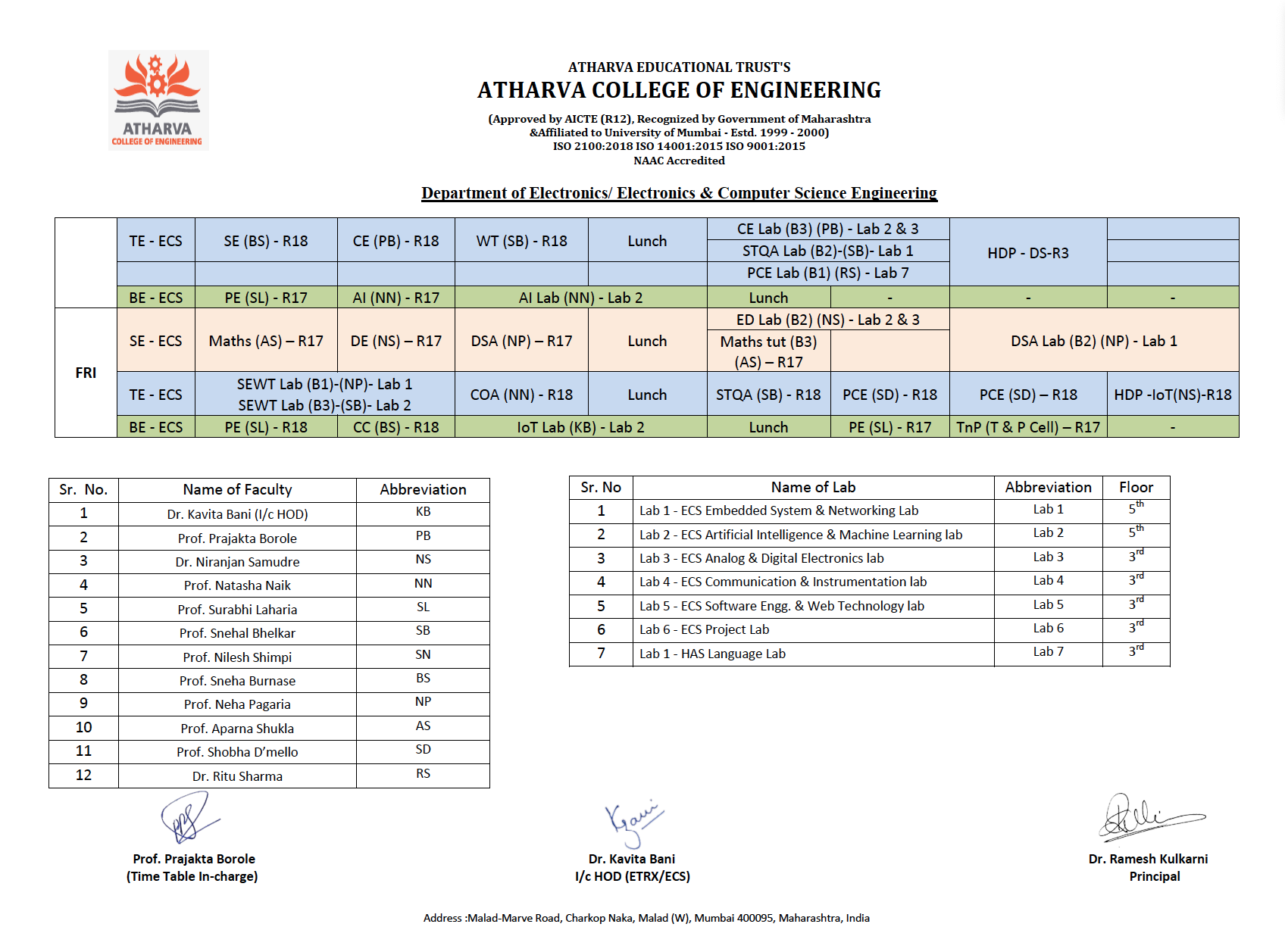
11
Toppers List AY 2022-23 (ODD)
| SEM 3 Toppers List | |||
| POSITION | NAME OF STUDENTS | CGPA | YEAR OF PASSING |
| FIRST | Shamit Shetty | 9.75 | 2023 |
| SECOND | Vedika Nemane | 8.85 | 2023 |
| THIRD | Tejas Jadhav | 8.75 | 2023 |
| SEM 5 Toppers List | |||
| POSITION | NAME OF STUDENTS | CGPA | YEAR OF PASSING |
| FIRST | Atithi Zimbar | 8.5 | 2023 |
| SECOND | Sapna Datta | 8.36 | 2023 |
| THIRD | Dineshchandra Joshi | 8.05 | 2023 |
| SEM 7 Toppers List | |||
| POSITION | NAME OF STUDENTS | CGPA | YEAR OF PASSING |
| FIRST | Anish Patil | 9.14 | 2023 |
| SECOND | Rathor Aditya | 8.57 | 2023 |
| THIRD | Saloni Naik | 8.43 | 2023 |
Toppers List AY 2021-22 (EVEN)
| SE | |||
| POSITION | NAME OF STUDENTS | CGPA | YEAR OF PASSING |
| FIRST | MOGHUL MOHD. RAZA MURTUZA | 8.5 | 2022 |
| SECOND | ZIMBAR ATITHI MANISH | 8.38 | 2022 |
| THIRD | SHINDE NEEL SHIVAJI | 8.21 | 2022 |
| TE | |||
| POSITION | NAME OF STUDENTS | CGPA | YEAR OF PASSING |
| FIRST | BHAVSAR TEENA SANJAY | 9.45 | 2022 |
| SECOND | KONDA SHREETHA BALAKRISHNA | 9.18 | 2022 |
| THIRD | RANGANATHAN RITIKA | 8.95 | 2022 |
| BE | |||
| POSITION | NAME OF STUDENTS | CGPA | YEAR OF PASSING |
| FIRST | KADGE RAJAS SUNIL | 9.58 | 2022 |
| SECOND | MINAT LISHA RAMESH | 9.22 | 2022 |
| THIRD | SURVE AJINKYA PRABHAKAR | 9.11 | 2022 |
| THIRD | JHAVERY DAKSH DEEPAK | 9.11 | 2022 |
Toppers List AY 2020-21 (EVEN)
| SE | |||
| POSITION | NAME OF STUDENTS | Pointers | YEAR OF PASSING |
| FIRST | MESTRY POOJA YADNYESHWAR | 9.5 | 2021 |
| FIRST | KONDA SHREETHA BALAKRISHNA | 9.5 | 2021 |
| FIRST | KADAM SAYLI SANJAY | 9.5 | 2021 |
| SECOND | GUPTA POOJA VINOD | 9.46 | 2021 |
| THIRD | JAIN ABHISHEK ASHOK | 9.42 | 2021 |
| TE | |||
| POSITION | NAME OF STUDENTS | Pointers | YEAR OF PASSING |
| FIRST | PATEL MOKSH MUKESH | 9.84 | 2021 |
| SECOND | PATIL HARSHADA VIJAY | 9.8 | 2021 |
| SECOND | KARANDE SNEHANJALI RAJESH | 9.68 | 2021 |
| THIRD | KATKAR JANHAVI DAYANAND | 9.69 | 2021 |
| BE | |||
| POSITION | NAME OF STUDENTS | Pointers | YEAR OF PASSING |
| FIRST | BHARDWAJ RONAK | 10 | 2021 |
| FIRST | SALDANHA BRANDON | 10 | 2021 |
| FIRST | MOHANTY CHINMAY | 10 | 2021 |
| FIRST | VASWANI GEETESH | 10 | 2021 |
| FIRST | SURYAVANSHI SHUBHAM | 10 | 2021 |
| FIRST | JADHAV ADVAIT | 10 | 2021 |
| SECOND | SHAH JUHI | 9.96 | 2021 |
| THIRD | BORE SHARVARI | 9.93 | 2021 |
Toppers List AY 2018-19 (EVEN)
| Class: S.E | |||
| Position | NAME OF STUDENTS | SGPI | Year Of Passing |
| FIRST | HITENDRA PATIL | 9.38 | 2019 |
| SECOND | SHRIDHAR SAHU | 9.17 | 2019 |
| THIRD | AAKASH PRAJAPATI | 8.9 | 2019 |
| Class: T.E | |||
| Position | NAME OF STUDENTS | SGPI | Year Of Passing |
| FIRST | AJAYAN SAROJ | 9.52 | 2019 |
| SECOND | RISHABH SANGHAI | 9.04 | 2019 |
| TEJVI TRIVEDI | |||
| THIRD | ABHISHEK MINGAL | 8.32 | 2019 |
| Class: B.E | |||
| Position | NAME OF STUDENTS | SGPI | Year Of Passing |
| FIRST | SHAKSHI SHETTY | 9.50 | 2019 |
| SECOND | TRUPTI YADAV | 9.46 | 2019 |
| THIRD | KHUSHBU PATEL | 9.13 | 2019 |
Toppers List AY 2018-19 (ODD)
| Class: S.E | |||
| Position | NAME OF STUDENTS | SGPI | Year Of Passing |
| FIRST | SAHU SHRIDHAR | 9.08 | 2019 |
| SECOND | KHANDAGALE AJAY | 8.52 | 2019 |
| THIRD | SHINDE PRASANNA | 8.48 | 2019 |
| Class: T.E | |||
| Position | NAME OF STUDENTS | SGPI | Year Of Passing |
| FIRST | SANGHAI RISHAB | 8.52 | 2019 |
| SECOND | SAROJ AJAYAN | 8.32 | 2019 |
| THIRD | TRIVEDI TEJVI | 8.26 | 2019 |
| Class: B.E | |||
| Position | NAME OF STUDENTS | SGPI | Year Of Passing |
| FIRST | SHRADDHA HEDGE | 9.26 | 2019 |
| SECOND | HARSHAL LELE | 8.59 | 2019 |
| THIRD | PACHANGE AAKANSHA | 8.52 | 2019 |
| FOURTH | SHETTY SAKSHI | 8.52 | 2019 |
| FIFTH | PATEL KHUSHBU | 8.52 | 2019 |
Research & Publication
| Sr. No |
NAME OF FACULTY
|
Total
|
|||
|
International Journals
|
International conferences
|
National Conferences
|
|||
| 1. | Dr. Kavita Piyush Bani | 10 | 12 | — | 22 |
| 2. | Ms. Prajakta Borole | 02 | 10 | 02 | 14 |
| 3. | Prof. Niranjan Samudre | 10 | 09 | 05 | 24 |
| 4. | Prof. Akansha Bhargava | — | — | — | — |
| 5. | Prof. Surabhi Laharia | 01 | — | 01 | 02 |
| 6. | Prof. Natasha Naik | 02 | 04 | 02 | 08 |
| 7. | Prof. Rupali Tirale | 02 | 03 | — | 05 |
| 8. | Prof. Nilesh Shimpi | — | 01 | — | 01 |
| 9. | Prof. Snehal Bhelkar | 01 | 01 | 01 | 03 |
| 10. | Prof.Neha Pagaria | 04 | 01 | 01 | 06 |
| 11. | Prof.Sneha Burnase | 02 | 04 | — | 06 |
2026 to 2027
2022 to 2023
- Alumni-report_ECS_25th-August-2023-2024
- ECS Dept workshop Report 23-08-2023
- Seminar-report_Angel-Investment_Dr.Amanpal-Chawla_24th-August-2023
- Report on “Achieving Value Proposition Fit & Business Fit” on 18th-August-2023
- NPTEL & MOOC Awareness (3 days workshop)
- S.E orientation report 17th July 2023
- Project Exhibition Report
- Alumni-talk On 13th April 2023, Department of Electronics & Computer Science
- Alumni-talk On 12th April 2023, Department of Electronics & Computer Science
- Webinar Neural Network- A Case Study on 2nd March 2023
- Report on Seminars on Skill Sets for Data Science on 18th January, 2023
2021 to 2022
- Workshop on “MATLAB & it’s Engineering Applications” on 21st September 2022
- Seminar on “Agile SDLC with OWASP protocols” on 25th August 2022
- Webinar Optical Communication 16th Feb 2022
- Webinar Wireless Network 16th Feb 2022
- Worshop on “Hybrid Mobile App Development using lonic” on 14th February 2022
- Seminar on “Image Processing Using OpenCV” on 18th January 2022
- Seminar on “Art of writing research paper” on 11th January 2022
2020 to 2021
- Webinar on “Employability Skills Enhancement” on 24th September 2021
- Webinar on “Design Thinking” on 8th September 2021
- Webinar on “Application of Robotics process Automation in Academics & Education Industry” on 13th August 2021
- Webinar on “Investor Awareness programme” on 27th July 2021
- Webinar on “Placement & Higher Education” on 23rd July 2021
- Webinar on “IEEE Xplore Digital Library for Academics & Research” on 13th July 2021
- Webinar on “Advance Technologies in Industrial Automation” on 6th May 2021
2019 to 2020
- Webinar on “MATLAB & Simulink Fundamentals & its Application in AI” on 23rd July 2020
- Seminar on “HAM Radio & Antenna” on 28th January 2020
2018 to 2019
- One Week Faculty Development Program on Cyber Security dated 3rd to 8th September 2019
- One day Workshop on Mobile App development & IT industry overview dated 11/09/2019
- Seminar on Space & Networking on 25/01/2019
- Virtual Class on “An Approach to AI & Data Science” by Ms.Aishwarya Wahane
- Virtual Class by Alumni Mr. Karan Kantharia( studying in Arizona State University, USA ) on “Introduction to Electric and Autonomous Vehicles”
- Report on Seminar on “Industrial Automation”
- Report on Seminar on “Career options & Profile building”
- Report on Seminar on “Space & Networking” 25/01/2019
- Workshop on “Development of Robotics” 23/01/2019
2017 to 2018
- Report on Seminar on “VLSI design and latest career trends” 13/09/2018
- One Day Workshop on PCB Designing 06/08/2018
- Workshop on “Wireless and Communication Networking” 7/2/2018
- Workshop-Wireless & Communication Networking
2015 to 2017
- Workshop on Remote embedded 2017-18
- Seminar on Matlab technical session 2016-17
- Nuclear Technology for National Development
- Video Analytics
- VLSI Digital Technique and SPICE
- Microprocessor & Microcontroller
- Seminar on Application of power electronics 2014-15
- Seminar need of electronics in industry for electronics engineer Effective use of DMM 2014-15
Session in First Half 2019
Session in First Half 2019 By Internal Faculties
|
Sr. No.
|
DATE
|
DEPARTMENT
|
NAME OF DEPARTMENT / ORGANISATION
|
TOPIC
|
TIME |
| 1. | 05-02-2019 | ETRX | Ameya Jadhav | Types of amplitude modulation | 10.00am – 11.00am |
| 2. | 05-02-2019 | ETRX | Ankur B | Flip flop basics | 12.00 pm – 01.00pm |
Session in First Half 2019 By External Faculties
|
Sr. No.
|
DATE
|
DEPARTMENT
|
NAME OF DEPARTMENT / ORGANISATION
|
TOPIC
|
TIME |
| 1. | 09-03-2019 | ETRX | KARAN KANTHARIA | INTRODUCTION TO ELECTRIC AND AUTONOMOUS VEHICLES | 12.00 pm – 01.00pm |
| 2. | 23-03-2019 | ETRX | AISHWARYA WAHANE | AN APPROACH TO AI AND DATA SCIENCE | 12.00 pm – 01.00pm |
Session in First Half 2018
Session in First Half 2018 By Internal Faculties
|
Sr. No.
|
DATE
|
DEPARTMENT
|
NAME OF DEPARTMENT / ORGANISATION
|
TOPIC
|
TIME |
| 1. | 21-07-2018 | ETRX | Namrata Lade | D C Circuits | 10.00 am |
| 2. | 21-07-2018 | ETRX | Sonam Kandalgaonkar | Spartan and Virtex family devices | 02.00 pm |
| 3. | 02-08-2018 | ETRX | Ankur B | Microcontroller and its application | 09.30 pm |
| 4. | 04-08-2018 | ETRX | Prajakta Borole | Diode as clippers | 09.15 am |
| 5. | 04-08-2018 | ETRX | Sarang Kulkarni | Fuzzy Logic | 10.30 am |
| 6. | 04-08-2018 | ETRX | Prajakta Borole | Clippers | 04.00 pm |
| 7. | 05-08-2018 | ETRX | Niranjan S | Displacement measurement | 03.00 pm |
| 8. | 21-09-2018 | ETRX | Sonam/Ankur | Planning | 09.50 pm |
| 9. | 24-09-2018 | ETRX | Ameya Jadhav | Coupled circuits | 07.50 pm |
Session in First Half 2018 By External Faculties
|
Sr. No.
|
DATE
|
DEPARTMENT
|
NAME OF DEPARTMENT / ORGANISATION
|
TOPIC
|
TIME |
| 1. | 22-09-2018 | ETRX | VIkas | Career in SOC | 11.30 pm |
A virtual class on “Ms in US” by harsh Shinde, alumini of Atharva college of engineering was conducted for third year and second year students. This virtual class was intended for those who want to pursue this higher education aboard and also provided a complete information on it.A total of 25 students attended the class.


Value Added Courses conducted during even semester
2.Seminar conducted by C.O.E (Pune) based on “Introduction of virtual lab useful in academics”
3.Virtual class conducted by Dr.Y.S.Rao (Vice principal)S.P.I.T based on “Embedded system’s“
- Report on Academic Industrial visit to AIPMA’s, Andheri (W) on 3rd & 4th Aug 2023
- One day Industrial Visit for students at MTNL Powai, on 6th March 2023.
- One day Industrial visit for TE Students at IIT Bombay, Powai, on 29th August,2019
- Electronics Engineering department 3 Days Industry Training at L & T campus” Madh Jetty Road , Madh Mumbai
- One day Industrial Visit for Electronics Students at Bisleri international Pvt Ltd
- One day Industrial Visit at Inter Solar on 8th February 2019
- One day Industrial Visit at ONGC’s Subir Raha Oil Museum, Dehradhun, Uttrakhand on 27th February,2019
- Report on One day Industrial Visit at IIT Bombay,Powai on 19th January,2019
- One day Indutrial Visit for Electronics Students at Bisleri international Pvt Ltd
- Report on One day Industrial Visit at AIR INDIA 4th September, 2018